
Srikumar महाराज🇮🇳☸️
103 days ago
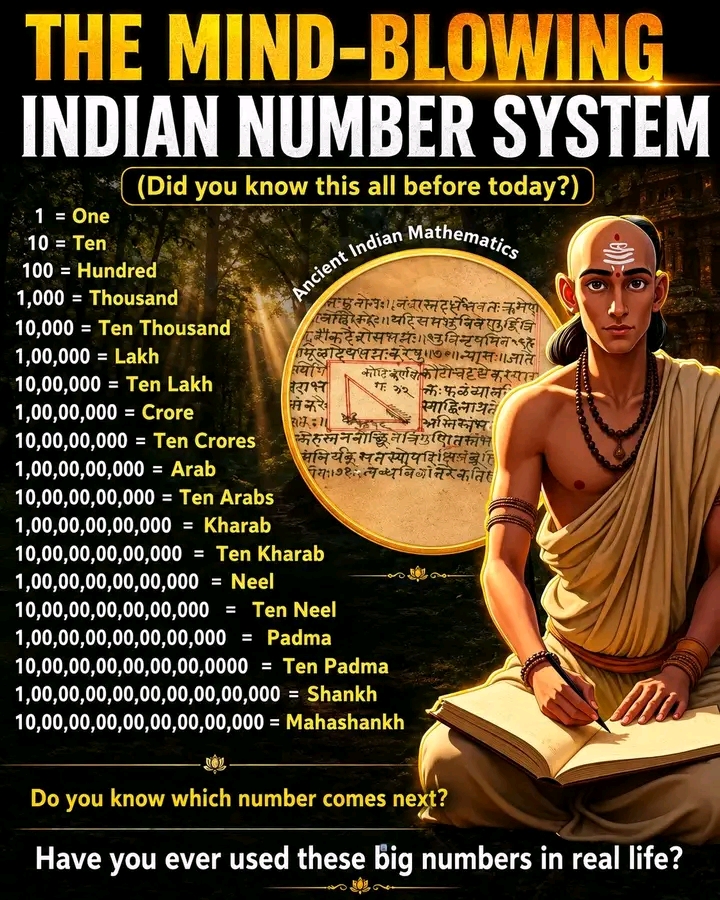
The Vedic Number System is older and deeper than you think. Long before many civilizations developed advanced mathematics, ancient Bharat had already conceptualized incredibly large numbers with unique names and a structured decimal system. 🇮🇳📚 From: 🔹 Lakh (1,00,000) 🔹 Crore (1,00,00,000) 🔹 Arab 🔹 Kharab 🔹 Neel 🔹 Padma 🔹 Shankh 🔹 Mahashankh …our ancestors understood the power of numbers on a scale unimaginable for that era. Ancient Indian mathematicians and Vedic scholars contributed immensely to: ➤ The decimal place value system ➤ The concept of zero (0) ➤ Astronomy & calculations ➤ Advanced arithmetic and geometry This was not just mathematics — it was a civilization deeply connected with logic, astronomy, philosophy, and the infinite nature of the universe. 🌌 The knowledge traditions of Bharat continue to inspire the modern world even today. 🚩
Comments (2)
Srikumar महाराज🇮🇳☸️
May 19, 2026
dhanyawad 🙏 Ram Ram raatri
Lal Singh 🇮🇳🇮🇳
May 19, 2026
इस चित्र में प्राचीन भारतीय संख्या प्रणाली (Indian Number System) को दर्शाया गया है, जो बहुत बड़े नंबरों को गिनने के लिए उपयोग की जाती थी। आपके चित्र के अंत में पूछे गए प्रश्न—**"Do you know which number comes next?" (क्या आप जानते हैं कि इसके बाद कौन सा नंबर आता है?)**—का उत्तर नीचे दिया गया है: ### महाशंख के बाद आने वाली संख्याएँ भारतीय संख्या प्रणाली में 'महाशंख' (10^{19}) के बाद भी बहुत बड़ी संख्याएँ आती हैं, जो इस प्रकार हैं: * **अल्य (Alp / Ald) / उपाध** = 1,00,00,00,00,00,00,00,00,00,000 (10^{21}) * **महाअल्य** = 10^{22} * **कंकु (Kanku)** = 10^{23} * **महाकंकु** = 10^{24} * **पार्ध (Pardha)** = 10^{25} * **महापार्ध** = 10^{26} * **भूरि (Bhuri)** = 10^{27} * **महाभूरि** = 10^{28} * **उत्संग (Utsang)** = 10^{29} > **रोचक तथ्य:** प्राचीन बौद्ध ग्रंथों (जैसे ललितविस्तर) और जैन गणितीय ग्रंथों में इससे भी कहीं बड़ी संख्याओं का उल्लेख मिलता है, जैसे **'असोंखेय' (Asankhyeya)** जो 10^{140} के बराबर होता है! > ### चित्र में दी गई सूची का हिंदी विवरण चित्र में दी गई संख्याओं को हिंदी में इस तरह समझा जा सकता है: | संख्या (अंकों में) | भारतीय नाम | वैज्ञानिक रूप (Scientific Notation) | |---|---|---| | 1 | एक | 10^0 | | 10 | दस | 10^1 | | 100 | सौ | 10^2 | | 1,000 | हज़ार | 10^3 | | 10,000 | दस हज़ार | 10^4 | | 1,00,000 | लाख | 10^5 | | 10,00,000 | दस लाख | 10^6 | | 1,00,00,000 | करोड़ | 10^7 | | 10,00,00,000 | दस करोड़ | 10^8 | | 1,00,00,00,000 | अरब | 10^9 | | 10,00,00,00,000 | दस अरब | 10^{10} | | 1,00,00,00,00,000 | खरब | 10^{11} | | 10,00,00,00,00,000 | दस खरब | 10^{12} | | 1,00,00,00,00,00,000 | नील | 10^{13} | | 10,00,00,00,00,00,000 | दस नील | 10^{14} | | 1,00,00,00,00,00,00,000 | पद्म | 10^{15} | | 10,00,00,00,00,00,00,000 | दस पद्म | 10^{16} | | 1,00,00,00,00,00,00,00,000 | शंख | 10^{17} | | 10,00,00,00,00,00,00,00,000 | महाशंख | 10^{18} *(चित्र में एक '0' की त्रुटि है, सही रूप 10^{18} या 10^{19} माना जाता है)* | आम तौर पर हम दैनिक जीवन में **करोड़** या **अल्फाज (लाख)** तक का ही इस्तेमाल करते हैं (जैसे देश की आबादी या बजट में), लेकिन प्राचीन भारत में खगोल विज्ञान (Astronomy) और ब्रह्मांड की आयु मापने के लिए इन महा-संख्याओं का उपयोग किया जाता था।