
Srikumar महाराज🇮🇳☸️
69 days ago
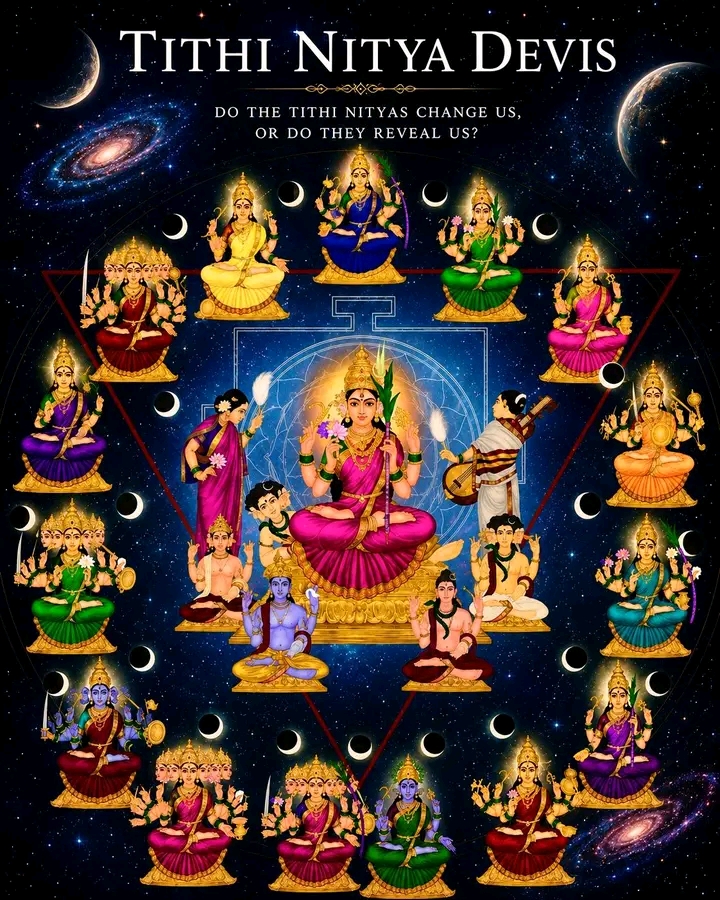
Tithi Nitya Devis – Part II Do the Tithi Nityas Change Us, or Do They Reveal Us? Not every day leaves the same impression on us. There are days we forget before they end, and there are days that remain with us for years. A single conversation can change a friendship. A moment of anger can damage a relationship. An unexpected kindness can restore our faith in people. The event itself may last only a few moments, yet somehow it continues to live within us long after the day has passed. Perhaps this is one of the quiet questions hidden within the contemplation of the Tithi Nityas. If the moon changes for everyone, why do the same experiences affect people so differently? Why does one person carry a small disappointment for years, while another lets it pass with little trace? Why do some moments become karma, while others simply become memories? Sri Vidya does not suggest that a sadhaka is someone who never experiences changing emotions. Joy, sorrow, hope, fear, success and failure belong to every human life. The Tithi Nityas themselves remind us that change is woven into the very fabric of creation. Just as the moon was never expected to remain full, perhaps the human heart was never expected to remain in one state. Yet Sri Vidya invites us to look beyond the obvious movement of emotions. The Tithi Nityas are not worshipped as fifteen identical forms of the Divine Mother. Each represents a distinct expression of Her power and a unique current of consciousness. Through them, Sri Vidya seems to suggest that not every phase of life carries the same inner quality. Some phases encourage growth, some test our stability, some intensify our desires, and others quietly draw us towards introspection. What becomes a source of strength in one phase can easily become a source of bondage in another. The difference, therefore, may not lie in what happens to us, but in how we respond to what happens. An ordinary person often becomes completely identified with each passing phase. Anger becomes identity, fear becomes habit, success becomes pride and disappointment becomes despair. The experience itself may pass, but the reaction remains, slowly shaping the mind and creating new patterns of karma. A sadhaka walks through the same world, under the same moon and through the same changing days. The emotions still arise, but there is an increasing awareness that they are temporary movements rather than permanent truths. Anger, fear, joy and sorrow are experienced fully, yet they are no longer allowed to define the whole of one's being. The phase is recognised, acknowledged and lived through, but it is not mistaken for the entirety of reality. Perhaps this is the lesson the moon has been teaching all along. Every phase has its place, yet no phase remains forever. The crescent does not cling to its beginning, and the full moon does not resist its decline. Both belong to the same rhythm. The Tithi Nityas invite us to recognise that our own lives move according to a similar rhythm. Change itself is not the problem. Bondage begins when we become attached to one phase or resistant to another. In this sense, the Tithi Nityas do not merely describe the changing moon. They offer a way of understanding the changing landscape of human experience. The ordinary person often assumes that the phase itself is reality. Sri Vidya gently shifts the perspective. Thoughts change, emotions change, circumstances change, yet the awareness that witnesses these changes remains. The moon waxes and wanes, but its light continues to belong to the same source. Perhaps this is why the Tithi Nityas are called Eternal. Their eternity does not lie in the permanence of any particular phase, but in the continuous presence of the Divine Mother through every phase. The waxing and waning belong to time, while the Nityas reveal the sacred presence that moves through time without ever being limited by it. The moon continues to change for everyone. The deeper question is not whether change will come, but what we create through each phase that comes before us. Every experience can become another layer of karma, or it can become an opportunity for awareness. The Tithi Nityas seem to remind us that the choice is not hidden in the moon, but in the way we learn to meet its changing light. Shri Matre Namaha 🙏🏽 🌸 Sai Srinivas Nandagopalan PhD Scholar working on Tantric Traditions
Comments (6)
Srikumar महाराज🇮🇳☸️
Jun 21, 2026
very nice 👍 🙏 Jai mataji 🙏 thank you dear
Rama Devi Sahu
Jun 21, 2026
"जब माता पार्वती ने पूछा — 'प्रभु, आपका सबसे प्रिय भक्त कौन है?' महादेव मुस्कुराए और बोले — 'जो मुझे नहीं, मेरे प्रेम को समझ ले, वही मेरा सबसे प्रिय है।' ❤️🔱" कैलाश की नीरवता में शिव और शक्ति साथ बैठे थे। वहाँ शब्द नहीं थे, केवल प्रेम था। और जहाँ प्रेम हो, वहीं शिव हैं... वहीं शक्ति हैं। 🙏🌺 Jai Mata Di 🌺🙏
Srikumar महाराज🇮🇳☸️
Jun 21, 2026
राधे-राधे बच्चा धन्यवाद🙏 कुश रहो

Jyoti Agarwal
Jun 21, 2026
राधे राधे 🙏
Srikumar महाराज🇮🇳☸️
Jun 21, 2026
महोदय, इसके लिए धन्यवाद। सनातन धर्म का अर्थ है ज्ञान साझा करना। हर किसी के साथ जय काल भैरव जी 🙏

RAKESH SHARMA OM NAMH SHIVAY 🥀🚩
Jun 21, 2026
आदरणीय सम्माननीय में आपकी सभी पोस्ट देखता हूं जी आप तो बहुत ज्यादा ही अच्छे प्रेरणा स्त्रोत प्रभावित करने वाले प्रस्तुति करते हैं आपकी तारीफ के लिए मेरे शब्द हल्के प्रतीत होते हैं आप अध्यात्म के विद्वान ज्ञाता हैंMY मंदिर को अध्यात्म जानकारी महत्वपूर्ण जानकारी प्रदान करते हैं आपका हार्दिक आभार शुभ रात्रि वंदन एवम स्नेहिल सादर नमन ॐ नमः शिवाय 🙏🙏🙏🙏🙏🌹🌹🌹♥️♥️